
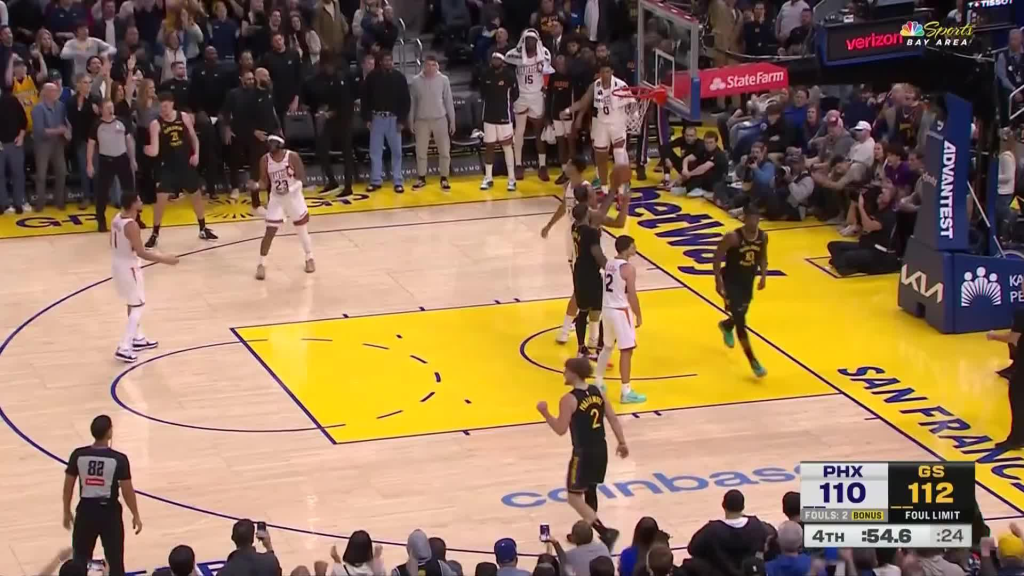
It wasn’t pretty for three quarters. The Warriors and Suns spent most of the first half trading runs — neither team pulling more than five or six points clear before the other answered. The kind of game where the score stays close not because both defenses are dominant, but because both offenses keep making the same mistakes at the same rate. Refs were calling everything. The crowd was into it anyway.
Curry changed the texture of it in the third. Back-to-back threes from well beyond the arc, neither of them catch-and-shoot — both coming off movement, with a hand in his face, against a defense that had specifically prepared for exactly this situation. That’s the thing about guarding him that no coach has fully solved in fifteen years of trying. You can build a scheme around containing Stephen Curry and he’ll still find a way to make you look like you didn’t. The Suns called a timeout after the second one, and when they came back out, something had shifted in how they were moving.
Booker kept them in it through sheer stubbornness. He’s at his best when a game turns physical and slightly desperate, and by the fourth quarter this one was both. He attacked the paint over and over, absorbing contact, drawing fouls, hitting mid-range jumpers that analytics departments across the league have spent years trying to coach out of players. For a stretch of about six minutes in the fourth, he was the best player on the floor — not by a little. The Warriors had no answer for him individually. They just had more answers collectively.
Durant was the variable neither team could completely account for. He doesn’t telegraph anything. He finds a spot, catches the ball, and scores with the kind of casual efficiency that makes it look like he’s not trying hard enough, even when he’s going for 28. Seven feet tall, guard’s footwork, release point so high that a legitimate contest still isn’t really a contest. He carried the Suns through two separate stretches where the offense broke down around him and he just kept producing anyway. In another game, that performance wins.
The Warriors closed it out by doing something that used to be uncharacteristic — slowing it down. Fewer possessions, better shot selection, methodical half-court execution that looked almost conservative against a team built for pace. Draymond Green was everywhere: screening, switching, making the right read every time Phoenix applied pressure and forced a decision. He didn’t score much. He didn’t need to. The win was constructed as much by what the Warriors chose not to do as by what they did.